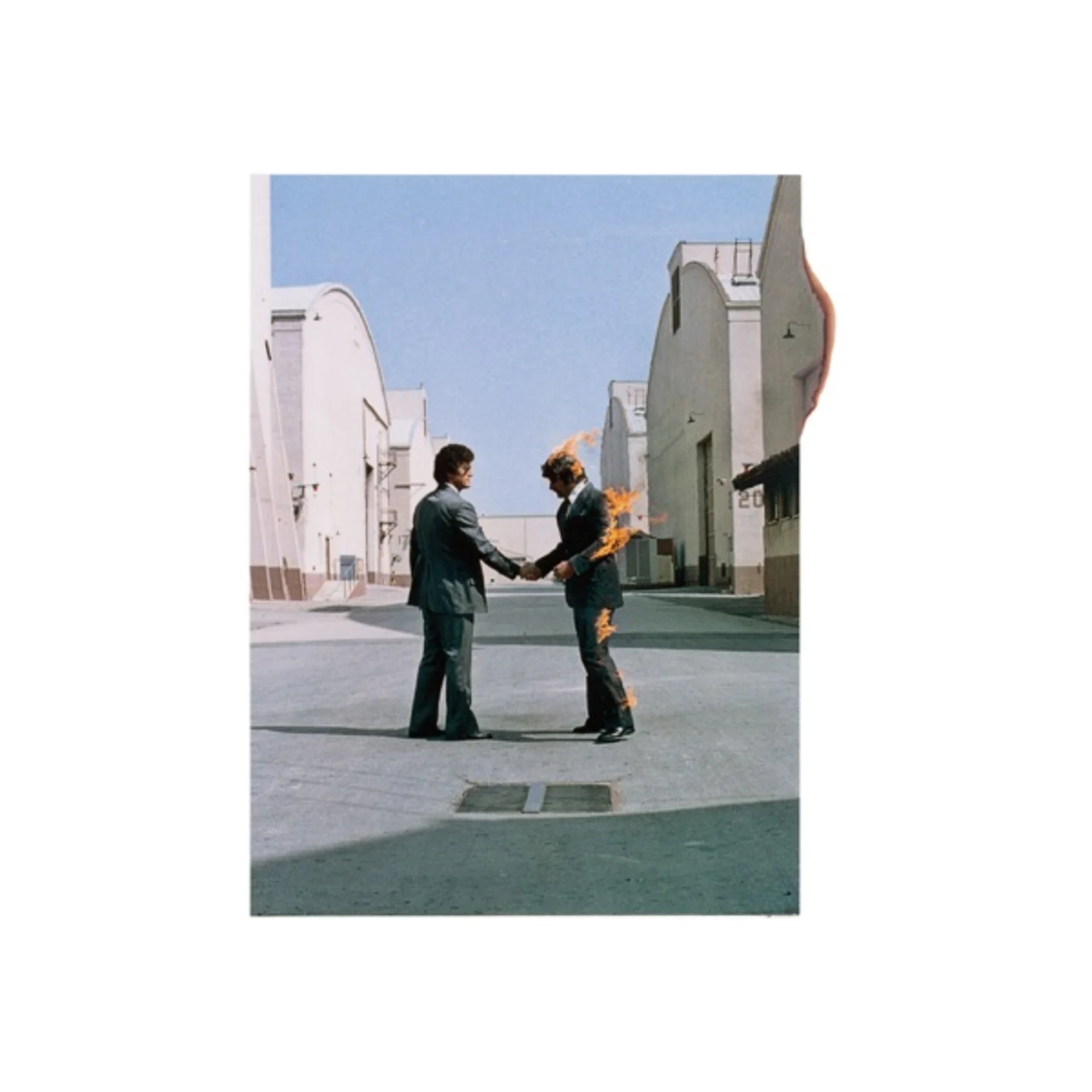
Wish You Were Here
Pink Floyd · 1975
- Designer
- Storm Thorgerson
- Photographer
- Aubrey Powell
- Label
- Harvest Records
- Decade
- 1970s
- Genre
- Rock
The cover for Wish You Were Here features one of the most dangerous photo shoots in album cover history — a businessman literally set on fire during a handshake with another suited figure. Aubrey Powell of Hipgnosis had to capture this shocking moment across fifteen takes before a gust of wind singed the stuntman's moustache and shut the shoot down for good, with safety crew standing by with fire extinguishers and blankets.
The concept emerged from Pink Floyd's deep frustration with the music industry and the emotional weight of losing founding member Syd Barrett to mental illness. Storm Thorgerson and Powell wanted to visualize the album's central theme of absence — the idea that people hide their true feelings for fear of getting burned. "Getting burned" was also music industry slang for artists being cheated out of royalties, and the handshake represented the hollow, transactional rituals of the business. The two businessmen were directly inspired by the album track "Have a Cigar," a sharp takedown of industry executives.
The photo shoot took place at Warner Bros. Studios in Burbank, California in 1975 — chosen, as Thorgerson and Powell explained, because it was "the land of make-believe; where nothing is real and all is absent." Powell used stuntman Ronnie Rondell Jr. as the burning figure, covering him in a fire-retardant suit beneath a business suit, with a protective hood hidden under a fireproof wig and fire-resistant gel applied to exposed skin. Each take required careful timing, precise lighting, and immediate extinguishing once the shot was captured.
The non-burning businessman was played by Danny Rogers, a professional Hollywood stuntman and member of Stunts Unlimited, who would go on to a forty-year career doubling for actors like Erik Estrada on CHiPs and performing stunts in films including Titanic, RoboCop, and Die Hard 2. The shoot took place on the studio's back lot with large soundstage buildings visible in the background. Because the wind direction didn't match their planned composition, Powell had the two stuntmen switch positions and shake with their left hands — the final image was then reversed in the darkroom so the burning figure would appear on the correct side.
Rondell was initially reluctant to do the stunt, telling Powell that standing still while on fire was far more dangerous than a typical action sequence — in a running shot, the flames trail behind you, but standing in place, they can blow directly into your face. Powell recalled that it was an unusually still afternoon, which gave them the confidence to proceed. The first fourteen takes went smoothly, but on the fifteenth, a small gust of wind shifted the flames into Rondell's face, singeing his moustache and burning off an eyebrow. His crew smothered him with blankets and extinguishers. Rondell got up and said, "That's it. No more." Powell knew he had the shot.
Storm Thorgerson had founded Hipgnosis with Aubrey Powell in the late 1960s, and they'd already created the iconic prism cover for The Dark Side of the Moon — designed by frequent collaborator George Hardie under their direction. Thorgerson's surrealist vision combined with Powell's technical photography skills made them the go-to team for Pink Floyd's conceptual needs. Their work influenced a generation of album cover designers and earned five Grammy nominations over Hipgnosis's fifteen-year run.
In a final conceptual flourish, Thorgerson and Powell chose to wrap the finished album in opaque black shrink-wrap, effectively making the cover art itself absent — a bold extension of the album's theme. The only identifying mark on the outside was a sticker featuring a mechanical handshake logo designed by George Hardie, a cold symbol of a gesture that should carry warmth but had been reduced to empty ritual. Columbia Records in the US objected strongly to the shrink-wrap decision, but Pink Floyd overruled them, and their commercial clout after The Dark Side of the Moon made the argument short.
The cover became an instant classic, frequently cited as one of the greatest album covers ever created. The image has been endlessly referenced and homaged across music, art, and popular culture — a testament to the power of a single, perfectly executed concept.
Hipgnosis created additional images for the album's inner sleeve and gatefold, building a complete visual narrative around the four classical elements: earth, fire, air, and water. These included a figure obscured behind a red veil billowing in the wind — representing air and continuing the theme of absence and concealment that ran throughout the album. The entire package, from the hidden cover to the elemental imagery inside, was designed as a unified artistic statement that matched the ambition of Pink Floyd's music.
On the evening of the cover shoot, Powell left a wrap party with assistant Peter Christopherson and noticed mist rising from the front of his Cadillac. Christopherson said, "Your car's on fire." They jumped out just before the car exploded and burned to the ground — a surreal coda to a day spent deliberately setting a man ablaze for art.
Get notified when we publish new cover stories. Download the Behind the Covers app and turn on notifications — a new album art deep dive, every day.
Loved the story behind Wish You Were Here? Hear the album or add it to your collection.
More by Pink Floyd
Also designed by Storm Thorgerson
More Rock Covers

More from the 1970s

Want to explore more?
Never miss a new cover story
Get the Behind the Covers app and turn on notifications — we publish new album art deep dives every day.