Goodbye Yellow Brick Road
Elton John · 1973
- Designer
- David Larkham
- Label
- DJM Records
- Decade
- 1970s
- Genre
- Rock
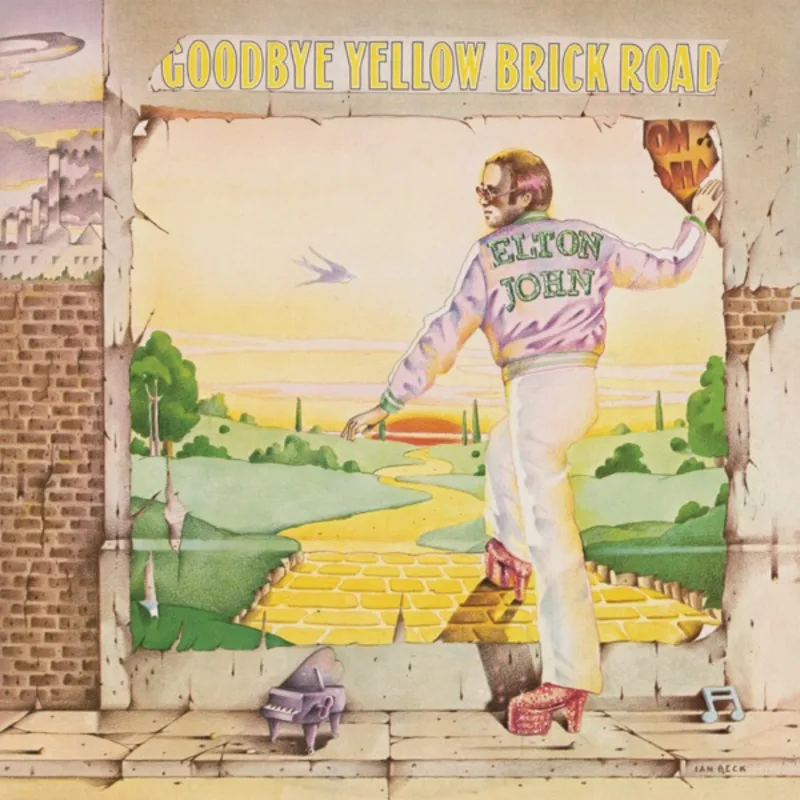
When Rocket Records executives spotted Ian Beck's illustration for Jonathan Kelly's Wait Till They Change The Backdrop album in 1972, they knew they'd found their artist. The cover showed dancers on stage with an industrial backdrop being lifted to reveal a pastoral scene beyond—a metaphor that seemed perfect for Elton John's upcoming double album.
Beck was called to a meeting at Rocket Records in 1973, where executives initially hoped to reuse his Jonathan Kelly artwork directly. When Beck explained this was impossible, they commissioned him to create entirely new artwork, giving him access to Elton's unreleased master tapes and Bernie Taupin's typed lyrics for inspiration.
Working from his shared studio space at 6 Garrick Street in Covent Garden, Beck had just ten days to design and illustrate the three outer panels of what would become a triptych gatefold cover. He enlisted his friend, fashion illustrator Leslie McKinley Howell, to pose as Elton John for Polaroid reference photographs, wearing a vintage American baseball jacket from a New York thrift store.
Beck's watercolor, pastel, and colored crayon artwork drew heavily on the 1930s Hollywood revival happening in 1973. He incorporated Art Deco design elements, the shadow of a palm tree, and the bonnet of a 1930s car to evoke the dream factory of Los Angeles. The cover showed Elton stepping through what appeared to be a poster into the famed yellow brick road.
Special requests came from "Elsie"—Beck's initial confusion about this mysterious figure was cleared when he realized the staff were referring to Elton himself. The piano on the front cover and teddy bear on the back were included specifically to please Elton, who loved pianos and collected teddy bears.
David Larkham served as art director and designer for the package, having worked with Elton since his early albums. Larkham was responsible for the overall design concept and coordination of the multiple illustrations across the six panels, which included individual artwork for each song on the double album.
The finished cover received immediate acclaim when the album was released on October 5, 1973. It perfectly captured the album's themes of nostalgia and escape, with Elton literally stepping away from the industrial cityscape visible in the upper left corner into Dorothy's magical realm.
Beck's illustration featured Elton in his characteristic platform boots and bomber jacket with his name emblazoned on it, stepping onto the yellow brick road with long, elegant legs—a result of using the tall Leslie McKinley Howell as his model. The rich colors and fantastical imagery became instantly recognizable.
The triptych design allowed for an unprecedented amount of visual storytelling across the gatefold format. Each panel contained detailed illustrations that complemented Bernie Taupin's cinematic lyrics, creating a complete artistic statement that enhanced the listening experience.
Beck's composition skillfully balanced realistic elements with fantasy, using warm yellows and earth tones that made the magical transformation feel tangible. The typography was integrated seamlessly into the illustration, with Elton's name appearing naturally on his jacket rather than as an imposed graphic element.
The cover's cultural impact was immediate and lasting. In 2023, Billboard ranked it as the 74th best album cover of all time, praising how it captured "the bedazzled rocker stepping into a poster of the famed yellow brick road." The Royal Mail honored it with a commemorative stamp in 2019.
Goodbye Yellow Brick Road became Elton's best-selling studio album, with over 30 million copies sold worldwide. The cover art played a crucial role in its success, creating an visual identity that matched the album's musical ambition and Bernie Taupin's literary aspirations.
The original artwork was lost when a record company executive claimed pieces for personal use—a common practice in 1973 before artists' rights were better protected. Beck later created new artwork for Elton's Farewell Yellow Brick Road tour, featuring a night sky and London's Shard building, bringing his iconic imagery full circle.
Get notified when we publish new cover stories. Download the Behind the Covers app and turn on notifications — a new album art deep dive, every day.
Loved the story behind Goodbye Yellow Brick Road? Hear the album or add it to your collection.
More Rock Covers
More from the 1970s


Want to explore more?
Never miss a new cover story
Get the Behind the Covers app and turn on notifications — we publish new album art deep dives every day.