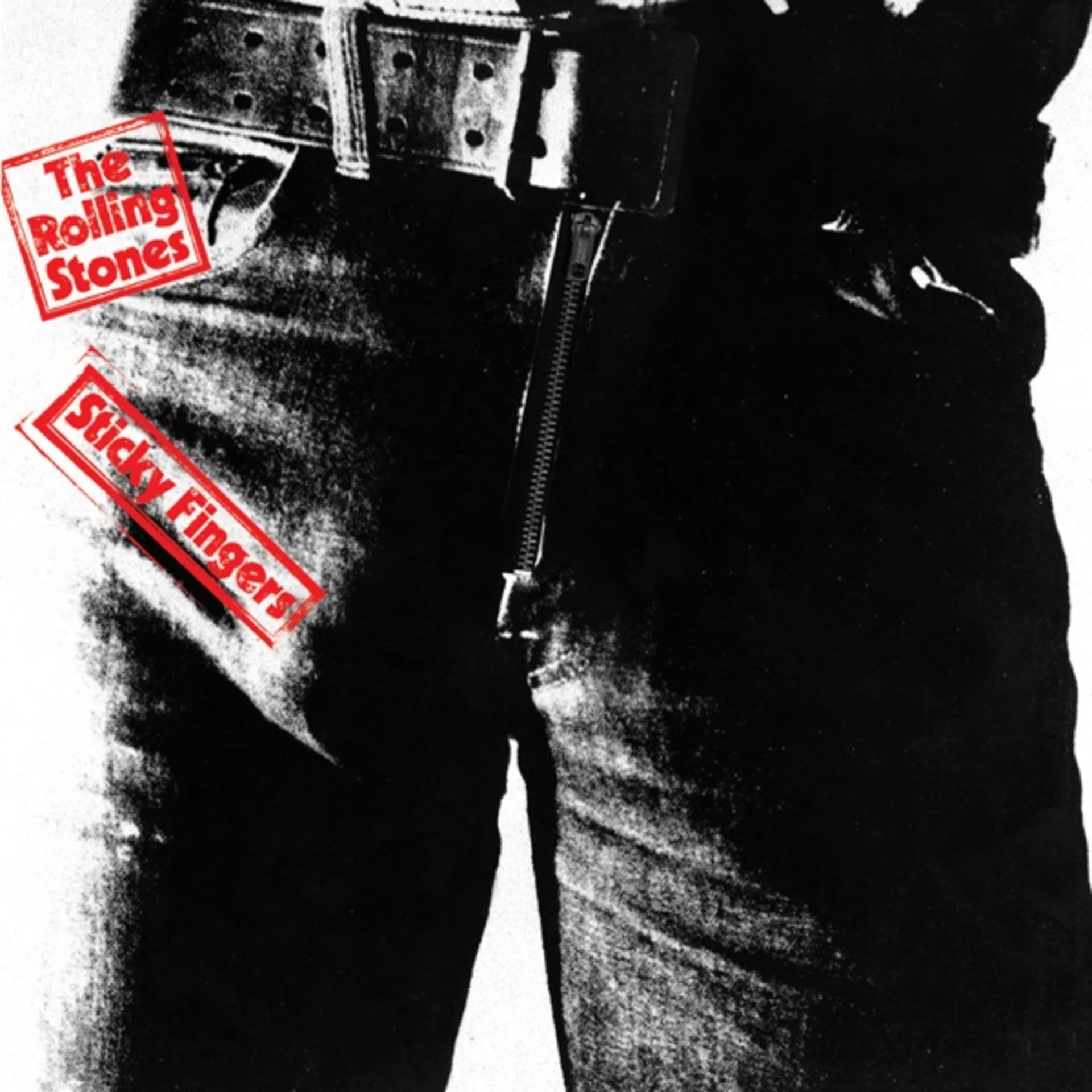
Sticky Fingers
The Rolling Stones · 1971
- Designer
- Andy Warhol
- Photographer
- Billy Name
- Label
- Rolling Stones Records
- Decade
- 1970s
- Genre
- Rock
Andy Warhol had already designed one iconic album cover when Mick Jagger asked him to create the artwork for the Rolling Stones' 1971 release. Where the Velvet Underground sleeve had been an exercise in minimalist reduction, Sticky Fingers was an exercise in tactile provocation. Warhol's concept was simple and outrageous: a close-up photograph of a man's crotch in tight jeans, with an actual working brass zipper embedded in the sleeve. The zipper could be pulled down to reveal a pair of cotton briefs printed on the inner sleeve beneath, transforming the album cover into an interactive object that was simultaneously a joke, a come-on, and a commentary on rock-and-roll sexuality.
The identity of the model in the photograph has been debated for decades. Warhol suggested several candidates over the years, and various associates have been credited, but the most commonly cited model is Joe Dallesandro, a Warhol superstar and Factory regular. The photograph was taken by Billy Name, though some sources credit Warhol himself. What matters more than the model's identity is the framing: the shot is cropped tightly at waist and mid-thigh, eliminating face, hands, and any identifying features above the belt line, reducing the human body to an anonymous erogenous zone.
The composition is deliberately confrontational. The bulge in the jeans occupies the center of the frame, unavoidable and unapologetic, lit with the flat, direct illumination of a fashion photograph or a department store catalog. The denim's texture is rendered with sufficient detail to feel tactile, the creases and shadows describing the body underneath with a precision that hovers between documentary and pornographic. The brass zipper, functional on the original pressing, adds a third dimension that most album covers lack: it invites touch, transforming the viewer into a participant.
The color palette is limited to the blue-grey of denim, the warm brass of the zipper, and the shadows of the folds, creating an image that is simultaneously monochromatic and rich in tonal variation. The simplicity of the palette focuses attention on texture and form rather than color, forcing the viewer to engage with the image's content rather than its surface beauty. When the zipper is pulled down, the transition from blue denim to white cotton creates a visual reveal that is both anticlimactic and suggestive, the underwear beneath being far less provocative than the promise of the zipper implied.
Warhol's design for the front carried no text at all, only the image and the zipper. The band name and album title appeared in a typeface designed to look like the letters had been cut from sticky tape and pressed onto the sleeve, the y in "Sticky" dripping downward in a visual pun that referenced both adhesive and bodily fluids. This lettering, positioned on the inner sleeve visible through the unzipped opening, was designed by Craig Braun, who also engineered the complex packaging that the zipper mechanism required.
The practical challenges of the working zipper were significant. The metal teeth scratched the vinyl record stored inside, and the packaging was far more expensive to produce than a standard sleeve. Later pressings replaced the functional zipper with a printed image of one, sacrificing the interactive element that made the original design so distinctive. The damage the zipper inflicted on the records created an unintentional metaphor: desire, the cover suggests, always leaves marks.
The back cover features a photograph by John Dominis showing a pair of hands reaching into the back pocket of similar jeans, but the front image is what seared itself into popular culture. In 1971, displaying a close-up of a male crotch on a major-label album was genuinely transgressive, and several countries initially refused to distribute the sleeve. Spain replaced it with a photograph of fingers emerging from a tin can, which somehow failed to capture the same energy.
Warhol's design for Sticky Fingers established a template for provocative album packaging that leveraged physical interaction with the sleeve. Its influence extends through the decades of increasingly elaborate vinyl and CD packaging, from the scratch-and-sniff covers of the 1980s to the interactive digital booklets of the streaming era. More importantly, it demonstrated that an album cover could be an object of desire in itself, a physical artifact whose tactile qualities created a relationship between the listener and the music before the needle ever touched the groove.
Get notified when we publish new cover stories. Download the Behind the Covers app and turn on notifications — a new album art deep dive, every day.
Loved the story behind Sticky Fingers? Hear the album or add it to your collection.
More by The Rolling Stones

Also designed by Andy Warhol
More Rock Covers




More from the 1970s



Want to explore more?
Never miss a new cover story
Get the Behind the Covers app and turn on notifications — we publish new album art deep dives every day.