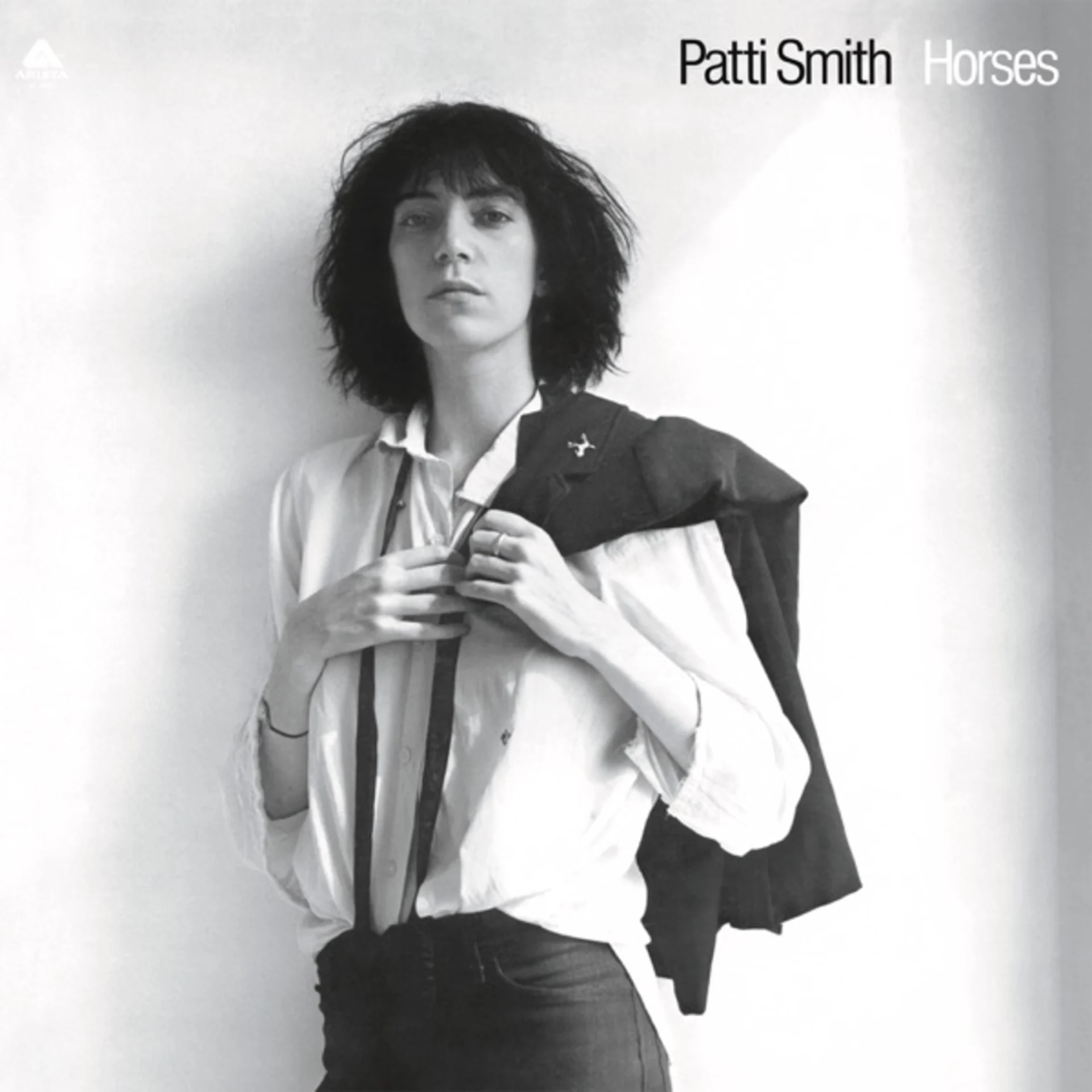
Robert Mapplethorpe photographed Patti Smith for the cover of Horses in the apartment they shared on the top floor of the Hotel Chelsea in New York. The year was 1975, and the two had been intimate friends, lovers, and creative collaborators since meeting at the Chelsea in 1967. Mapplethorpe was not yet the celebrated and controversial photographer he would become; he was still finding his way, shooting friends and lovers with a Polaroid camera and experimenting with the medium-format Hasselblad that would later produce his most famous work. The cover of Horses was one of the images that announced his arrival.
The photograph shows Smith standing against a white wall in a white shirt, a thin black ribbon tie at her throat, a jacket slung over one shoulder and held by a hooked finger. Her body is turned slightly away from the camera, but her face is directed forward, her gaze meeting the lens with an intensity that is neither inviting nor hostile but simply, absolutely present. The shirt is a men's dress shirt, crisp but not starched, its whiteness creating a field of light against which Smith's angular features and dark hair register with the clarity of a charcoal drawing.
The composition is almost shockingly simple: a figure against a wall, shot from waist level with natural light from a nearby window. There are no props, no set design, no atmospheric effects, just Smith and the space she occupies. The jacket over the shoulder is the image's single dramatic gesture, a reference to Sinatra's rat-pack cool that Smith reclaims for her own androgynous purpose. The thin black tie adds a vertical accent that draws the eye from her collar to her chin, emphasizing the length of her neck and the sharpness of her jawline.
Mapplethorpe's lighting, a single window source creating soft, directional illumination, produces gentle shadows on one side of Smith's face that give the portrait depth without drama. The light falls on the shirt and wall with an evenness that makes the whites glow, creating an overall brightness that reads as clarity or revelation. The shadow under Smith's jaw and the darker tone of the wall behind her head provide just enough tonal contrast to separate the figure from the ground and give the image its sculptural quality.
The color palette is virtually monochromatic: the white of the shirt and wall, the black of Smith's hair and tie, the warm grey of the shadows, and the olive tone of Smith's skin. This restricted palette gives the image a timeless quality, equally at home in 1975, 1955, or 1925. The absence of color also focuses attention on form and expression, the two elements that Mapplethorpe's work would continue to prioritize throughout his career. The photograph proves that visual power comes from what is excluded as much as from what is included.
Smith's androgynous presentation was radical in the context of 1975 popular music. Female artists on album covers were expected to conform to recognizable categories of feminine beauty: glamorous, sexy, wholesome, or mystical. Smith's image refused all of these. The men's shirt, the flat chest, the angular face, the direct gaze, the absence of makeup or jewelry, the Frank Sinatra shoulder gesture: every element combined to create a portrait of gender as performance, of femininity as something that could be donned, discarded, or reinvented at will.
The typography on the original Arista pressing places Smith's name and the album title in a clean, modern font below the photograph, maintaining the cover's elegant simplicity. The text is secondary to the image in every sense, a caption rather than a design element, allowing Mapplethorpe's photograph to dominate the sleeve with the authority of a gallery print.
The cover of Horses has been called the greatest rock portrait ever taken, and its influence on how female musicians present themselves visually is immeasurable. It opened a space for androgyny, intensity, and intellectual seriousness that Debbie Harry, Siouxsie Sioux, PJ Harvey, and countless others would occupy in their own ways. But the image's power transcends its historical significance: fifty years later, it remains startling in its directness, its refusal to accommodate the viewer's expectations, its insistence that a woman looking straight at the camera, with nothing to sell and nothing to prove, is the most compelling image imaginable.
Get notified when we publish new cover stories. Download the Behind the Covers app and turn on notifications — a new album art deep dive, every day.
Loved the story behind Horses? Hear the album or add it to your collection.
More Rock Covers

More from the 1970s
Want to explore more?
Never miss a new cover story
Get the Behind the Covers app and turn on notifications — we publish new album art deep dives every day.