Sgt. Pepper's Lonely Hearts Club Band
The Beatles · 1967
- Designer
- Peter Blake & Jann Haworth
- Photographer
- Michael Cooper
- Label
- Parlophone / Capitol
- Decade
- 1960s
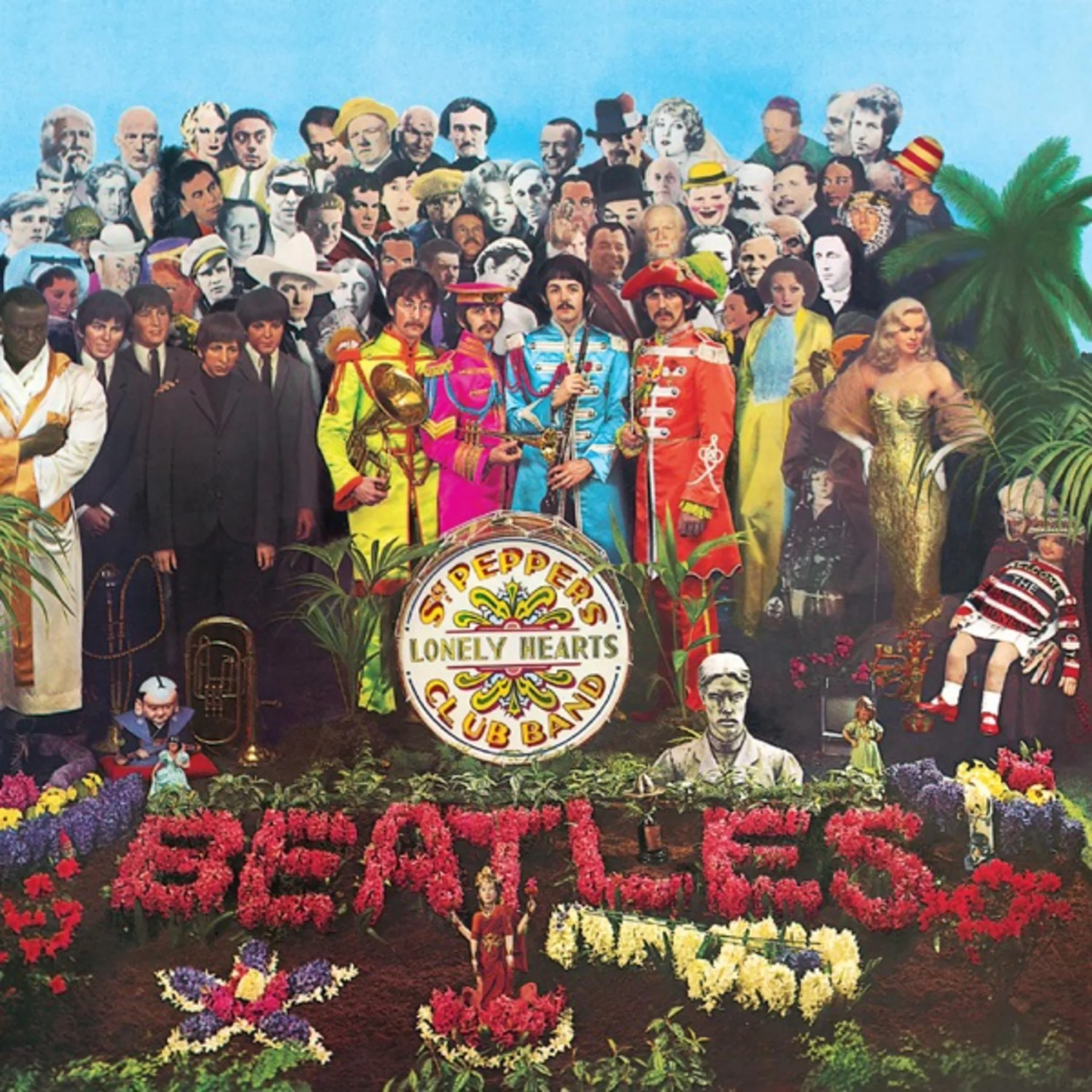
The idea began with Paul McCartney on an airplane. Flying back to London in late 1966, he imagined the Beatles reinventing themselves as an Edwardian brass band, a fictional alter ego that would free them from the expectations crushing the most famous group in the world. When it came time to visualize this concept, McCartney and art dealer Robert Fraser recruited pop artist Peter Blake and his wife, the sculptor Jann Haworth, to create a life-sized tableau that would become the most expensive and most influential album cover ever produced up to that point.
Blake and Haworth assembled a crowd of seventy-three life-sized cardboard cutouts representing the Beatles' collective heroes, arranged in a tiered group photograph behind the band in their DayGlo military uniforms. The figures were chosen by each Beatle from a wish list: Lennon wanted Jesus and Hitler, both of whom were vetoed. The final crowd includes Aleister Crowley, Mae West, Karl Marx, Marlene Dietrich, Bob Dylan, Aubrey Beardsley, Edgar Allan Poe, Stockhausen, and dozens of others, creating an impossibly democratic assembly where high culture and pop culture stand shoulder to shoulder. Wax figures of the Beatles in their earlier Madame Tussauds incarnation stand alongside, gazing down at a floral display that spells BEATLES in red hyacinths.
Photographer Michael Cooper shot the tableau on March 30, 1967, at Chelsea Manor Studios. The set was constructed as a real three-dimensional installation, not a photographic composite, which gives the image its peculiar depth and presence. Every cutout was hand-colored and mounted on hardboard, and the props scattered in the foreground, a portable television, a cloth doll wearing a Rolling Stones shirt, a garden gnome, a hookah, were selected for maximum semiotic density. The production cost nearly three thousand pounds, roughly fifty thousand in today's money, a sum that made EMI executives physically uncomfortable.
The lighting is flat and even, deliberately eliminating shadow to create the quality of a Victorian group photograph or a fairground backdrop. This anti-dramatic illumination gives the image its uncanny quality: everything is equally visible, equally present, with no atmospheric hierarchy to guide the eye. The result is an image that must be read rather than glanced at, a visual text that rewards prolonged study. Cooper's camera sits at eye level with the band, making the viewer a participant in the crowd rather than an observer from outside.
The color palette announced the arrival of full-spectrum psychedelia into mainstream visual culture. The military uniforms blaze in electric blue, magenta, orange, and gold, their saturated hues clashing joyfully against the muted sepia tones of the historical cutouts behind them. This chromatic collision between past and present, between the monochrome dignity of dead heroes and the Technicolor exuberance of the living band, is the cover's central visual argument: history is raw material to be remixed, not a museum to be preserved.
The drum at the center bears the album's full title in a circus-poster typeface painted by fairground artist Joe Ephgrave, integrating the text into the image rather than floating it above or below as a caption. This was revolutionary. The back cover broke equally new ground by printing the complete song lyrics, a first for any major rock album, treating the words as literature deserving the same care as the visual art. The gatefold interior featured a Peter Blake collage of military insignia and a cardboard sheet of mustache and badge cutouts, extending the participatory, playful spirit of the project.
The cover's symbolic density has spawned decades of academic analysis and conspiracy theorizing. The inclusion of Aleister Crowley fed narratives about the Beatles' supposed occult affiliations. The wax figures of the pre-Sgt. Pepper Beatles staring mournfully at a grave suggested a ritual death and rebirth. The hand raised above McCartney's head in an apparent benediction was interpreted as an Eastern death sign. Whether these readings have any validity is beside the point; the cover's genius is that it is rich enough to sustain them.
Blake's method of assembling a personal cultural pantheon created a template that has been endlessly quoted, from Frank Zappa's satirical response on We're Only in It for the Money to the Simpsons' Yellow Album, each iteration confirming the original's status as the foundational text of album art. It won the Grammy for Best Album Cover and established the principle that cover design could be a legitimate art form worthy of gallery exhibition, critical analysis, and serious financial investment. Every concept album that followed, from Tommy to The Wall to Beyonce's Lemonade, exists in its shadow.
Get notified when we publish new cover stories. Download the Behind the Covers app and turn on notifications — a new album art deep dive, every day.
Loved the story behind Sgt. Pepper's Lonely Hearts Club Band? Hear the album or add it to your collection.
More by The Beatles
More Rock Covers


More from the 1960s
Want to explore more?
Never miss a new cover story
Get the Behind the Covers app and turn on notifications — we publish new album art deep dives every day.