Remain in Light
Talking Heads · 1980
- Designer
- Tibor Kalman / M&Co
- Label
- Sire
- Decade
- 1980s
- Genre
- RockElectronic
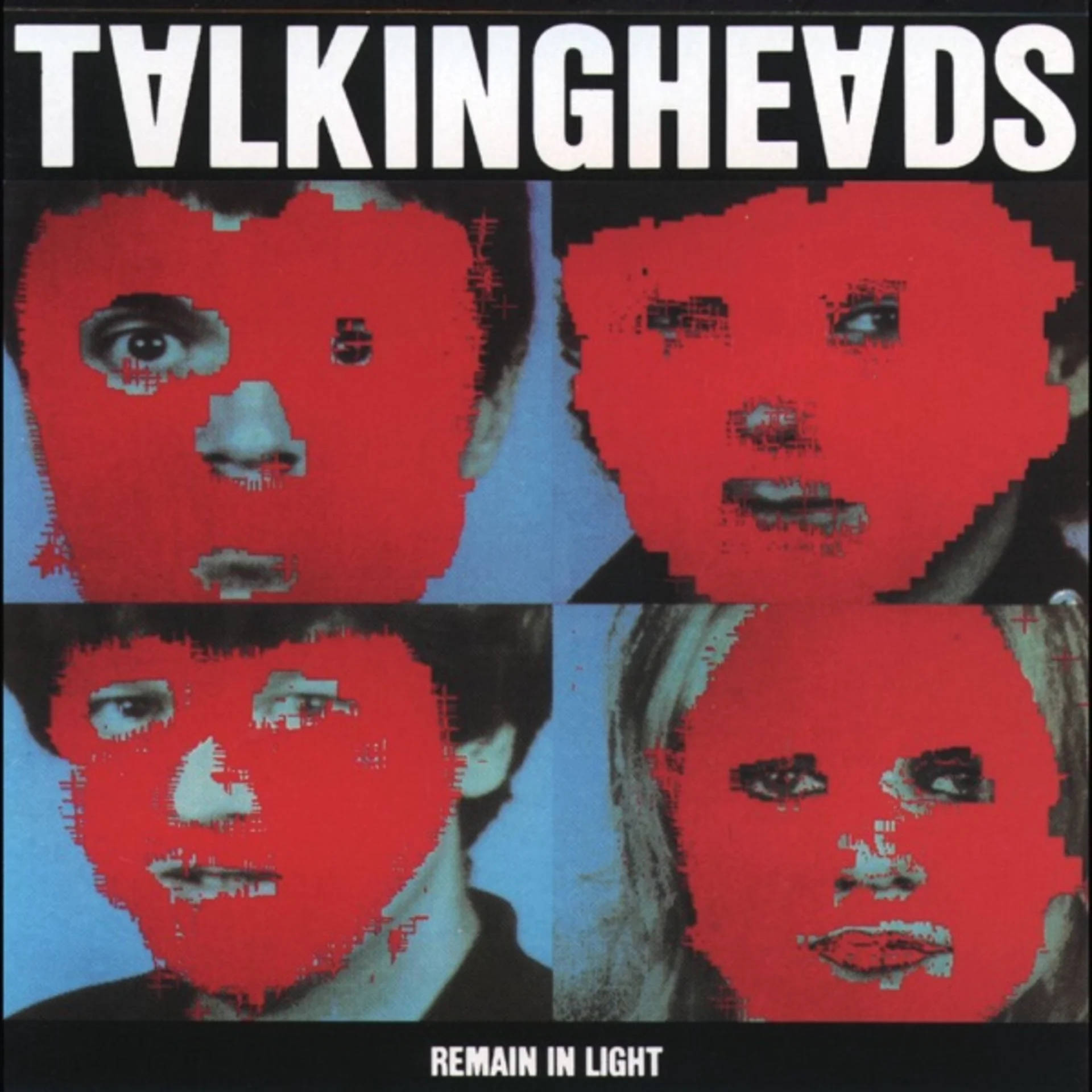
Tibor Kalman was not yet the legendary graphic designer he would become when he designed the cover for Talking Heads' 1980 album Remain in Light. Working with the band and their longtime creative collaborators, Kalman produced an image that was at once simple and deeply unsettling: four portraits of the band members with their features obscured by blocks of saturated red ink, rendered in the coarse halftone dots of newspaper printing. The faces are recognizable in outline but erased in detail, present and absent simultaneously.
The technique Kalman used was a form of image processing that anticipated the digital manipulation tools that would not become widely available for another decade. The band members' photographs were reproduced using an exaggerated halftone screen that broke the images into visible dots, then overlaid with translucent red that unifies the four separate portraits into a single chromatic field. The result is an image that reads as both photograph and abstraction, both portrait and mask, a visual equivalent of the album's own dissolution of individual identity into collective rhythm.
The composition arranges the four portraits in a tight grid, two over two, with minimal spacing between them. The uniformity of treatment, each face receiving the same red overlay, the same halftone degradation, the same cropping, deliberately suppresses individual personality in favor of group identity. This was a pointed statement from a band whose creative process had shifted from David Byrne's singer-songwriter model to a collaborative approach influenced by Brian Eno's ideas about collective creativity and African polyrhythmic structures.
The red that dominates the cover is not a single flat hue but a complex field of warm and cool variations created by the halftone dots interacting with the underlying photographic tones. In areas of shadow, the red deepens toward burgundy; in highlights, it warms toward orange. This tonal variation prevents the image from reading as a simple color filter effect and gives it a painterly quality that rewards close examination. The red carries multiple associations: heat, anger, political revolution, the physical body, the blood that connects the individual to the collective.
Kalman's typography for the album is as radical as the image treatment. The band name and album title appear in a clean, utilitarian sans-serif font, but the letters of the band members' names are scattered across the cover in apparently random positions, as though they have been thrown at the surface and allowed to land where they may. Some letters are upright, others rotated; some cluster near the portraits, others drift toward the edges. This typographic dispersal is a visual metaphor for the album's deconstruction of the traditional rock band hierarchy, where the frontman's name dominates and the rhythm section is relegated to fine print.
The back cover extends the design language with additional processed photographs and the same scattered typography, creating a visual environment that wraps around the physical object of the sleeve. The inner sleeve contains lyrics printed in the same fragmented layout, making the text as challenging to parse as the distorted imagery on the cover. Every element of the packaging reinforces the album's central thesis: that meaning emerges from patterns, not from individual elements, and that the collective is more powerful than the sum of its parts.
Computer scientist Walter Bender of MIT's Media Lab contributed to the image processing, using early digital tools to achieve the halftone effects that give the portraits their distinctive texture. This collaboration between a graphic designer, a rock band, and a computer scientist was ahead of its time, anticipating the interdisciplinary approach to visual culture that would become standard in the digital age. The cover was one of the first to be significantly shaped by computer processing, even though the final result was printed using traditional offset lithography.
Remain in Light's cover established a visual vocabulary for art-rock that persisted through the 1980s and beyond. Its fusion of photographic portraiture, graphic processing, and political typography influenced everyone from Peter Saville's work for New Order to the Designers Republic's output for Warp Records. The image's central insight, that distorting a familiar face can communicate more about identity than a clear photograph, anticipated the aesthetics of digital culture by decades, making it one of the most prescient designs in album art history.
Get notified when we publish new cover stories. Download the Behind the Covers app and turn on notifications — a new album art deep dive, every day.
Loved the story behind Remain in Light? Hear the album or add it to your collection.
More by Talking Heads
More Rock Covers



More from the 1980s


Want to explore more?
Never miss a new cover story
Get the Behind the Covers app and turn on notifications — we publish new album art deep dives every day.