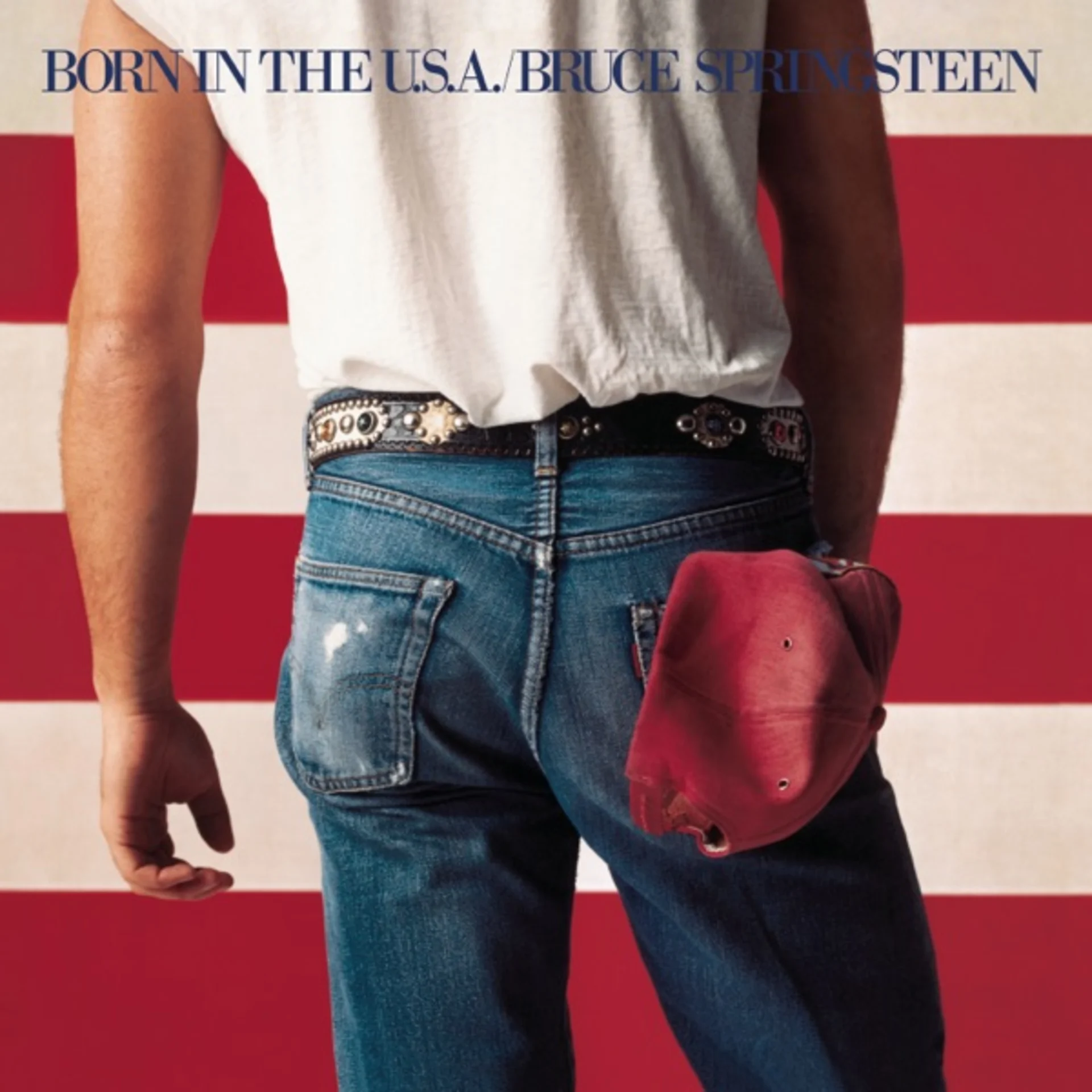
Annie Leibovitz photographed Bruce Springsteen from behind, from the waist down to just above the knees, capturing his backside in faded blue jeans against an American flag so large it fills the entire background. Springsteen's left hand is relaxed at his side while a red baseball cap hangs from his right rear pocket, a casual gesture that reads as both working-class authenticity and studied nonchalance. The photograph was taken during the album sessions in 1984 and became one of the most recognized and most misunderstood images in American popular culture.
Leibovitz, already established as one of the premier portrait photographers in America through her work for Rolling Stone and Vanity Fair, shot the image with her characteristic combination of editorial polish and emotional directness. The lighting is clean and even, with no dramatic shadows or atmospheric effects, giving the photograph the straightforward quality of a snapshot despite its obvious art direction. The even illumination is important: it refuses to romanticize or mythologize the subject, presenting Springsteen's jeans and the flag with the same matter-of-fact clarity.
The composition is remarkable for what it excludes. By photographing Springsteen from behind, Leibovitz eliminates his face, the primary vehicle for personality and charisma in rock portraiture. What remains is a body, specifically a male working-class body in denim, positioned against the national symbol. The image reduces Springsteen to his most fundamental visual signifiers: American maleness, physical labor, blue-collar identity, and the flag that claims to represent all of these things. The absence of the face universalizes the figure; this could be any American man, which is precisely the album's lyrical territory.
The flag fills the entire background, its stripes creating a bold graphic pattern of red and white that dominates the image's color palette. The blue of Springsteen's jeans echoes the blue field of stars in the flag's upper corner, creating a chromatic continuity between the man and the nation that the album's lyrics would complicate and ultimately challenge. The flag is not pristine: it is slightly wrinkled, its fabric catching the light unevenly, suggesting use and age rather than ceremonial display. This imperfection humanizes the symbol.
The red baseball cap in the back pocket provides a small but crucial accent of warm color that draws the eye to the center of the composition and breaks the symmetry of the jeans and flag. Its casual placement suggests a man who has just come from work or is about to return to it, grounding the patriotic symbolism of the flag in the physical reality of labor. The cap is a working man's accessory, not a political prop, and its presence insists on the material, embodied nature of American identity against the abstraction of the flag's symbolism.
The typography on the original release places Springsteen's name and the album title in a bold, rectangular block of red and blue text at the top of the sleeve, echoing the flag's color scheme and creating a visual unity between text and image. The font is assertive but not aggressive, appropriate for both a rock album and a patriotic statement, which is part of the design's brilliance: it accommodates multiple readings without committing to any of them.
The cover was immediately and widely misread. Ronald Reagan's 1984 re-election campaign attempted to co-opt Springsteen as a symbol of conservative patriotism, apparently without listening to the album's lyrics, which document unemployment, Vietnam trauma, class betrayal, and the hollowness of the American Dream. The image's ambiguity enabled this misreading: a flag and a pair of jeans can be read as celebration or critique depending on the viewer's predisposition, and the absence of Springsteen's face prevents his expression from resolving the question.
The cover's lasting significance lies in this very ambiguity. It demonstrated that the most powerful political images are not those that declare a position but those that create a space for competing interpretations. Leibovitz's photograph remains a Rorschach test for American identity: you see in it what you bring to it, and what you see reveals more about you than about the man in the jeans.
Get notified when we publish new cover stories. Download the Behind the Covers app and turn on notifications — a new album art deep dive, every day.
Loved the story behind Born in the U.S.A.? Hear the album or add it to your collection.
More by Bruce Springsteen
More Rock Covers

More from the 1980s



Want to explore more?
Never miss a new cover story
Get the Behind the Covers app and turn on notifications — we publish new album art deep dives every day.