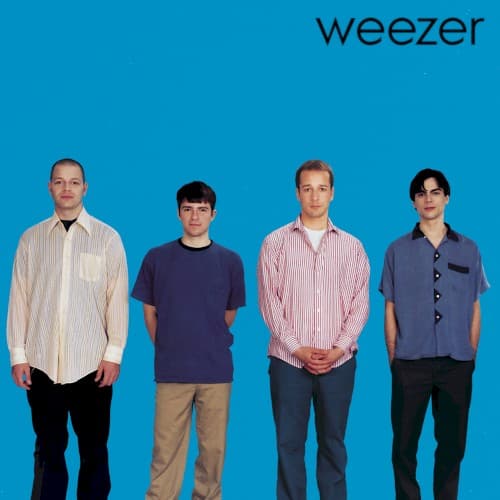
Karl Koch, the band's longtime friend and unofficial fifth member, photographed Weezer for the cover of their 1994 debut against a flat blue background so saturated it has given the album its unofficial title. The four members stand in a line, shoulder to shoulder, facing the camera with expressions that range from Rivers Cuomo's uncertain half-smile to the other members' various degrees of awkward composure. They wear the ordinary clothes of 1990s college students: rumpled button-downs, T-shirts, corduroys, and sneakers. There is no styling, no art direction in the conventional sense, no attempt to make the band look like rock stars.
The blue background is the cover's defining element, a uniform field of rich, saturated blue that fills every pixel of the image not occupied by the four human figures. The blue is warm enough to read as inviting rather than clinical but cool enough to maintain a sense of detachment, creating an emotional temperature that perfectly matches the album's music: songs of romantic longing and social awkwardness delivered with melodic warmth but emotional distance. The blue provides no information about place, time, or context; the band exists in a void of pure color.
The composition is almost defiantly straightforward: four guys standing in a row, centered in the frame, shot from approximately waist level with a standard lens that introduces no distortion or dramatic perspective. The lighting is flat and even, the kind of illumination found in a school photo studio or a corporate headshot session. There are no shadows, no dramatic highlights, no atmospheric effects. The image's refusal of visual drama is itself a dramatic statement in the context of 1994's alternative rock landscape, where bands competed for dark, tortured, or edgy visual identities.
The band members' appearance and body language communicate a specific anti-image that would become enormously influential. Cuomo's thick-rimmed glasses, which he wore out of necessity rather than fashion, became the defining visual accessory of geek rock. The members' visible discomfort in front of the camera, their stiff postures and uncertain expressions, was not a calculated affectation but a genuine reflection of four introverts who had not yet learned to perform for the lens. This visible awkwardness became the cover's secret weapon: in an era of carefully crafted alternative cool, honest awkwardness read as refreshingly authentic.
The color interactions between the blue background and the band members' clothing create a limited but effective palette. The muted tones of their casual wear, greens, browns, and blues that happen to echo the background, are enlivened by occasional accents of white and the warm tones of their skin. The blue dominates overwhelmingly, reducing the human figures to small islands of texture and personality within a sea of pure hue. This relationship between the vast background and the small figures communicates a sense of insignificance that is both humorous and poignant.
The typography places the Weezer logo and the band name in a simple font at the bottom of the image, maintaining the cover's commitment to unpretentious directness. The text does not float or layer over the image but sits below it, secondary to the photograph in every sense. The word "Weezer" in its characteristic font became one of rock's most recognizable wordmarks, its slightly rounded letterforms suggesting the same combination of softness and confidence that the music delivers.
Koch's photograph was taken in a single session that lasted less than an hour, without the elaborate preparation, multiple wardrobe changes, and post-production processing that major-label album shoots typically involve. This economy of production is visible in the final image, which has the directness and slight imperfection of a well-taken snapshot rather than the calculated perfection of a studio portrait.
The Blue Album's cover became a visual template that Weezer themselves would reference and riff on throughout their career, releasing subsequent self-titled albums with different monochrome backgrounds: green, red, white, teal, black. But none achieved the cultural impact of the original blue. The cover's influence extends beyond the band to the broader landscape of 1990s and 2000s rock, where the anti-image of ordinary people standing against plain backgrounds became a viable alternative to the glamour and grit that had previously defined rock photography.