To Pimp a Butterfly
Kendrick Lamar · 2015
- Designer
- Dave Free & Kendrick Lamar
- Photographer
- Denis Rouvre
- Label
- Top Dawg / Aftermath / Interscope
- Decade
- 2010s
- Genre
- Hip-Hop
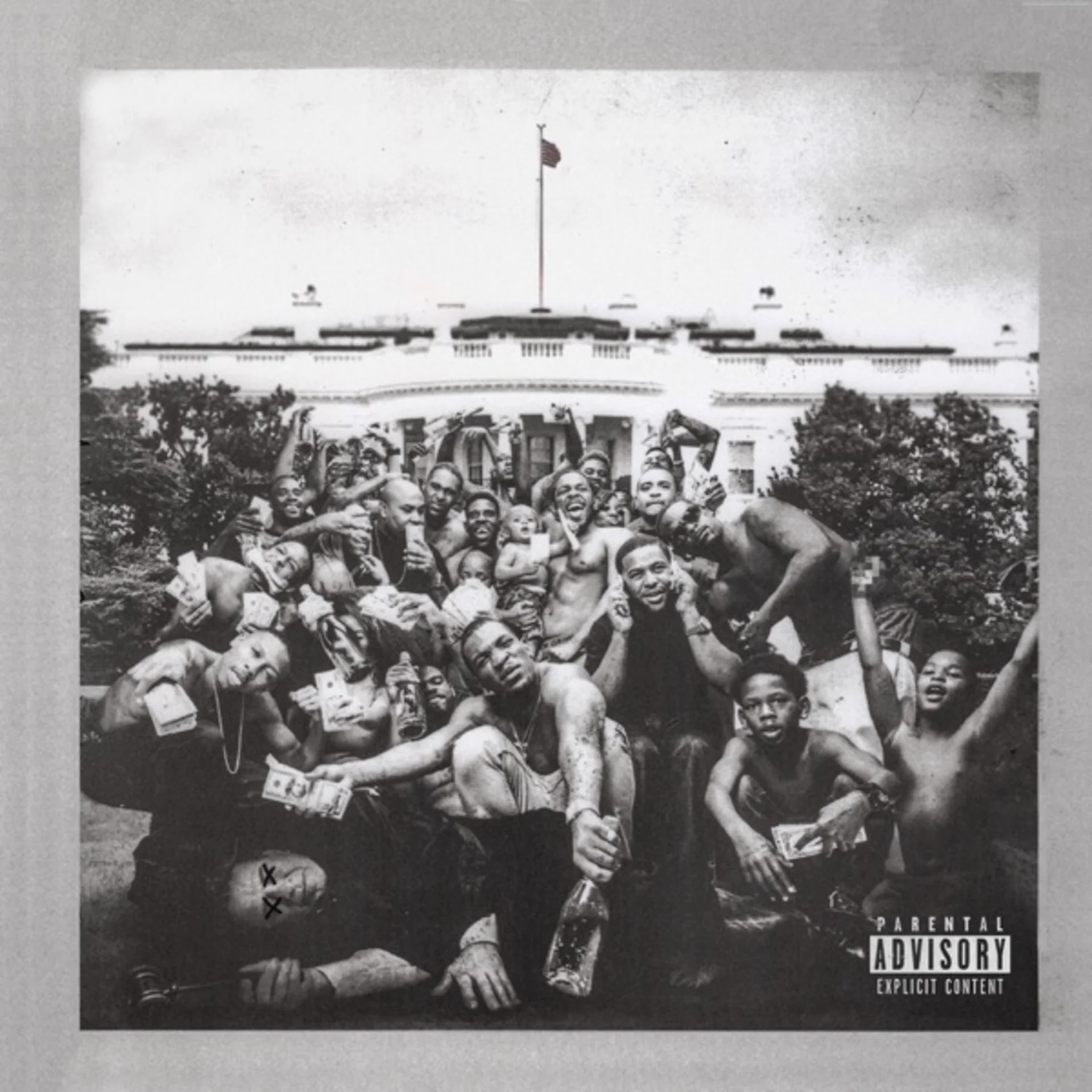
The cover of Kendrick Lamar's 2015 masterwork presents a large group of Black men and boys posed on the White House lawn, drinks raised in celebration, a dead judge at their feet, with a scowling Secret Service detail visible in the background. The image was not a photograph in the traditional sense but a carefully staged tableau conceived by Kendrick, Dave Free of Top Dawg Entertainment, and their creative team, then composited from multiple photographic elements by photographer Denis Rouvre and designer Vlad Sepetov into a single, confrontational image.
The concept inverts the visual language of power in American political photography. Group photos on the White House lawn are traditionally reserved for dignitaries, visiting heads of state, championship sports teams, people who have been invited into proximity with power. Kendrick's image fills that space instead with shirtless men, toddlers, forty-ounce bottles, and stacks of cash, claiming the seat of American institutional authority for the people it has systematically excluded. The dead or unconscious figure in a suit, eyes covered by X marks, lies at the group's feet like a conquered adversary.
The composition is organized around a rough pyramid structure with Kendrick positioned at the center rear, slightly elevated, his eyes direct and confrontational. The group radiates outward from this anchor point in a seemingly chaotic arrangement that actually follows the classical conventions of Renaissance group portraiture. Every figure is engaged in a distinct action, holding money, raising a bottle, posing with a child, creating the density of narrative incident that Bruegel packed into his peasant scenes. The White House itself, rendered in crisp focus behind the group, provides an architectural frame that heightens the contrast between institutional formality and street-level vitality.
The color palette is warm and saturated, dominated by skin tones ranging from deep brown to golden amber, the green of the White House lawn, and the white of the building itself. The warm colors of the human figures push forward against the cooler architectural background, creating a visual hierarchy that privileges bodies over buildings, people over institutions. Small accents of red, blue, and gold appear in clothing and accessories, but the overall impression is of warm flesh against cool stone, the organic against the monumental.
The image's visual grammar draws from multiple traditions simultaneously. The group pose echoes the conventions of hip-hop crew photography, where the posse shot communicates collective strength and territorial claim. The architectural backdrop and compositional formality reference official state portraiture. The presence of children and domestic detail recalls the tradition of family photography. By layering these registers, the cover creates a new visual vocabulary that cannot be reduced to any single genre or tradition.
The typography is minimal: the artist's name and album title appear in a small, clean sans-serif font at the top of the image, deliberately understated so as not to compete with the photograph's density of incident. The title "To Pimp a Butterfly" in white text sits quietly above the scene, its provocative language contrasting with its visual restraint. This typographic humility is appropriate for an album that lets its content, both musical and visual, speak at full volume without the amplification of graphic design.
The Parental Advisory label in the lower right corner functions as an inadvertent design element, its black-and-white rectangle echoing the stark contrasts within the image and serving as a reminder that the cover's celebration is also a provocation. Every element in the image, from the cash to the children to the dead judge, carries political weight, and the cumulative effect is of a single photograph that contains an entire argument about race, power, celebration, and defiance in America.
The cover immediately took its place alongside the most politically charged images in hip-hop history, but its ambition exceeds genre. By staging a scene of Black joy and Black community on the grounds of the White House, by claiming that space for ordinary people rather than political elites, the image makes a statement about belonging and ownership that resonates far beyond the album's musical context. It is a cover that demands to be read as carefully as the lyrics within, and it rewards that attention with layers of meaning that reveal themselves over repeated viewings.
Get notified when we publish new cover stories. Download the Behind the Covers app and turn on notifications — a new album art deep dive, every day.
Loved the story behind To Pimp a Butterfly? Hear the album or add it to your collection.
More by Kendrick Lamar

More Hip-Hop Covers



More from the 2010s


Want to explore more?
Never miss a new cover story
Get the Behind the Covers app and turn on notifications — we publish new album art deep dives every day.