Mezzanine
Massive Attack · 1998
- Designer
- Tom Hingston
- Photographer
- Nick Knight
- Label
- Virgin / Circa
- Decade
- 1990s
- Genre
- Electronic
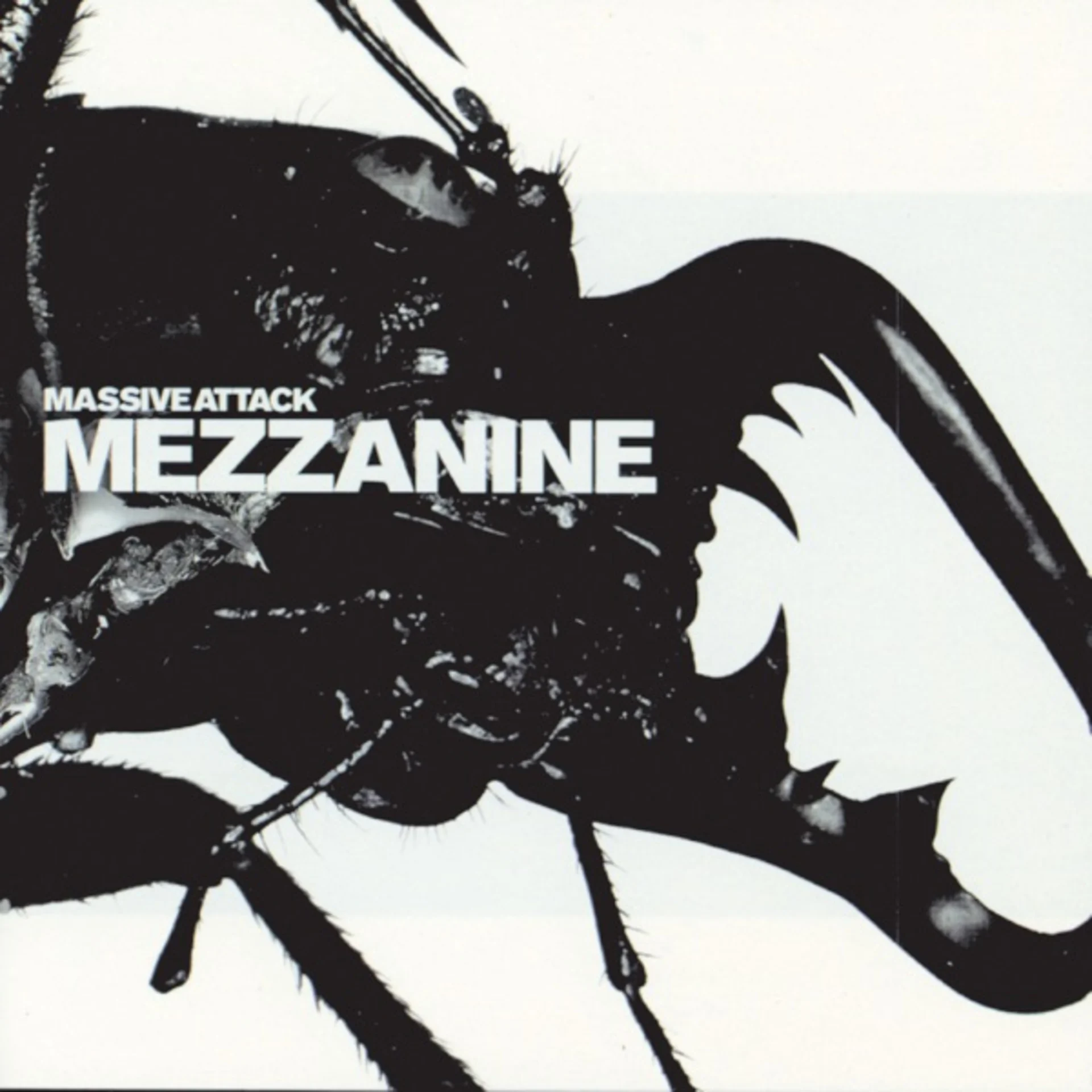
The cover of Massive Attack's third album presents one of the most unusual subjects in album art history: an extreme macro photograph of a stag beetle, its exoskeleton rendered in such magnified detail that the insect becomes an alien landscape of chitin, mandibles, and segmented limbs. The image was created under the art direction of Tom Hingston, with input from the band, particularly Robert Del Naja, who had been a graffiti artist before co-founding Massive Attack and maintained an intense interest in visual art throughout the band's career.
The photograph transforms the beetle through sheer scale. At the magnification used, the insect's familiar form becomes almost unrecognizable: the mandibles read as industrial machinery, the compound eyes as dark screens, the exoskeleton's surface as armored plating on a military vehicle. This defamiliarization through extreme close-up is the image's central strategy, taking something that would ordinarily provoke nothing more than a passing glance or a shudder and forcing the viewer to confront it as an object of terrible beauty.
The composition fills the frame entirely with the beetle's head and thorax, leaving no background visible and providing no spatial context. The insect occupies the image as completely as a planet fills a telescope's field of view, creating a sense of overwhelming presence that is both intimate and threatening. The shallow depth of field, inherent to macro photography, means that only a narrow band of the beetle's surface is in sharp focus at any point, with the rest fading into soft-focus darkness. This selective focus guides the eye across the image like a flashlight beam moving over an alien surface.
The color palette is almost entirely monochromatic, built from the deep browns, blacks, and dark ambers of the beetle's natural coloring. The warm tones of the exoskeleton glow against the pure black of the background, creating a visual warmth that contradicts the image's unsettling content. Occasional highlights where the surface catches the studio lighting produce tiny points of brightness that give the chitin a polished, almost liquid quality. The restricted palette concentrates the viewer's attention on texture and form, the two qualities that macro photography reveals most dramatically.
Hingston's design places the band name and album title in a clean, white sans-serif font against the dark background, positioning the text at the top of the sleeve where it reads clearly against the blackness surrounding the beetle. The typography is crisp and modern, creating a sharp contrast with the organic complexity of the photograph. This juxtaposition of mechanical letterforms and biological form mirrors the album's own fusion of electronic production with organic instruments and vocals.
The beetle's symbolic associations are rich and deliberately ambiguous. In ancient Egypt, the scarab beetle was a symbol of transformation and rebirth. In European culture, beetles have been associated with death, decay, and the underworld. In the context of Mezzanine's dark, paranoid music, the insect reads as an emblem of the hidden life that thrives in darkness, the subterranean world of anxiety and desire that the album's songs explore. The mandibles, visible in close-up as instruments of crushing and cutting, add a note of implicit violence.
The rest of the album's packaging extends the macro-photography aesthetic with additional close-up images of organic subjects, creating a visual world where the very small becomes monumental and the familiar becomes strange. The booklet functions as a kind of microscope, revealing hidden worlds within ordinary objects, which is precisely what Massive Attack's music does with sound: taking familiar elements, a sample, a vocal phrase, a bass note, and magnifying them until they fill the entire sonic space.
Mezzanine's cover established a visual identity for the album that was as distinctive and immediately recognizable as the music itself. The beetle image has become iconic within electronic and trip-hop culture, representing an aesthetic of dark beauty and obsessive attention to detail that mirrors the painstaking production methods for which Massive Attack are renowned. The design proved that album art need not depict human subjects or recognizable landscapes to create a powerful emotional response, and that sometimes the most evocative image is the one that forces the viewer to look at what they would normally overlook.
Get notified when we publish new cover stories. Download the Behind the Covers app and turn on notifications — a new album art deep dive, every day.
Loved the story behind Mezzanine? Hear the album or add it to your collection.
More by Massive Attack
More Electronic Covers


More from the 1990s



Want to explore more?
Never miss a new cover story
Get the Behind the Covers app and turn on notifications — we publish new album art deep dives every day.