 1 / 2
1 / 2The Rise and Fall of Ziggy Stardust and the Spiders from Mars
David Bowie · 1972
- Designer
- Terry Pastor
- Photographer
- Brian Ward
- Label
- RCA Records
- Decade
- 1970s
- Genre
- Rock
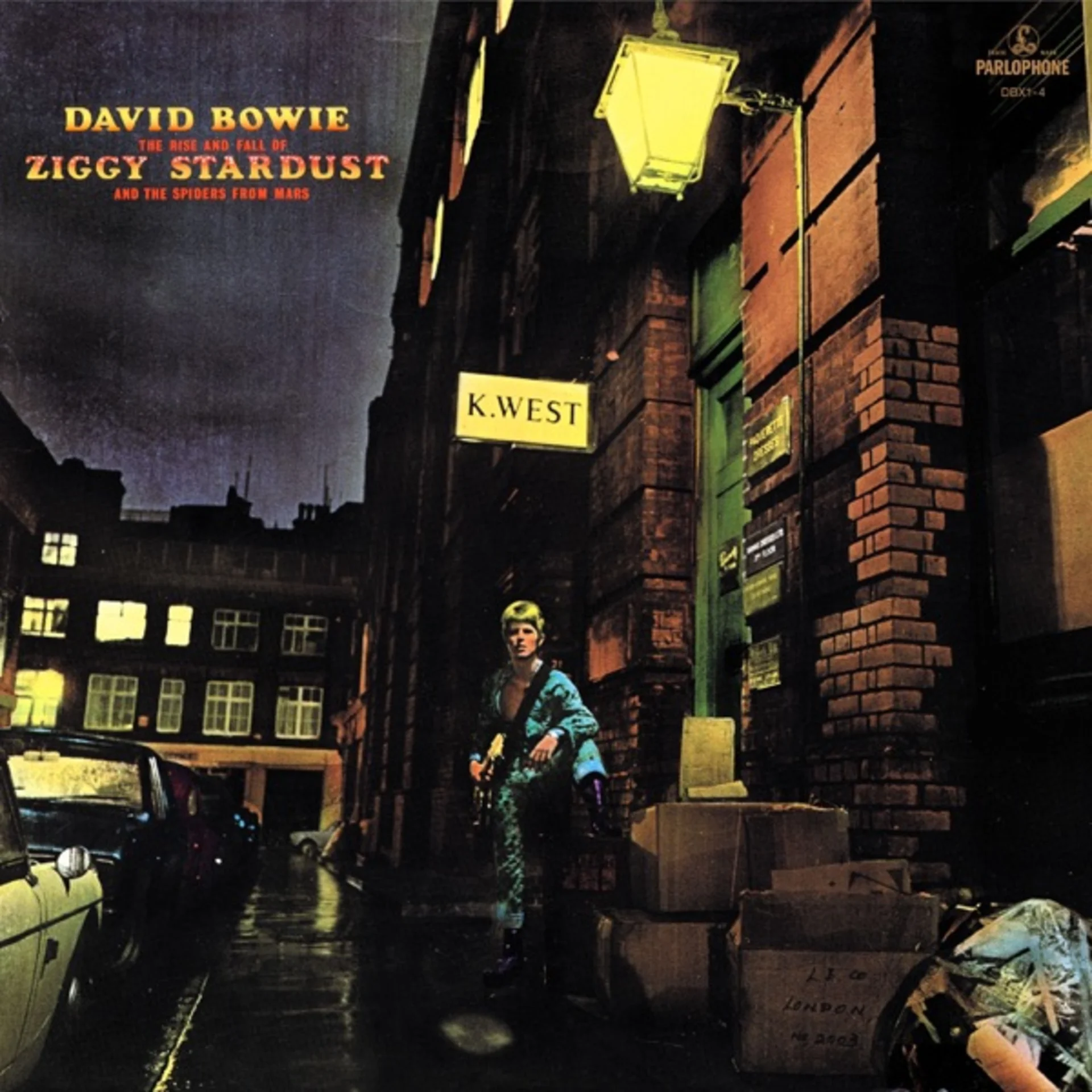
The photograph that would introduce the world to Ziggy Stardust was taken on a rainy January night in 1972 on Heddon Street, a narrow cul-de-sac just off Regent Street in London's West End. Photographer Brian Ward set up his equipment beneath the glow of a single streetlamp while David Bowie posed in the doorway of a furrier's shop, wearing a quilted jumpsuit and platform boots, his hair freshly dyed a shade of red that the nighttime color film rendered as an otherworldly orange. Ward shot several rolls as Bowie moved through a sequence of poses, but the image chosen for the cover captures him mid-stride, one foot raised from the wet pavement, his guitar case visible nearby, a solitary figure arriving from or departing to somewhere unknowable.
The Heddon Street location was not chosen for its glamour but for its ordinariness. The backstreet's unremarkable architecture, a phone box, a cardboard box in the gutter, the K.WEST sign on the wall that fans would later misread as a Kanye West prophecy, provided a mundane backdrop against which Bowie's extraterrestrial presence registered with maximum impact. The contrast between the alien figure and the drizzly London backstreet is the image's essential drama: Ziggy Stardust has landed not in Times Square or Piccadilly Circus but in a forgotten alley where nobody is watching.
Ward lit the scene using the available streetlight supplemented by a carefully positioned strobe that illuminated Bowie without destroying the nighttime atmosphere. The result is an image where Bowie's figure glows against the surrounding darkness, his costume catching the light in highlights that define its quilted texture and metallic sheen. The wet pavement reflects both the streetlamp and the strobe, creating a mirror effect that doubles the light sources and adds depth to the composition. The rain-slicked surfaces give every element a jewel-like clarity that dry pavement would not provide.
The composition places Bowie slightly right of center, his body forming a dynamic diagonal as he steps forward. The phone box and doorway behind him provide vertical framing elements that anchor the figure in architectural space, while the receding perspective of the street creates a depth that draws the eye past Bowie into the darkness beyond. The ground-level camera angle, shot from approximately Bowie's knee height, lends him a looming, monumental quality that belies his slender frame. He looks down at the camera, and by extension the viewer, with an expression that mingles invitation with challenge.
The color palette is defined by the interaction of tungsten streetlighting and photographic film, producing a warm amber cast that saturates the entire image. The reds and oranges of Bowie's hair and suit glow against the brown-gold of the wet street and the blue-black of the night sky. This limited, warm palette gives the image a cohesive atmosphere that reads as simultaneously nostalgic and futuristic, as though Ziggy has arrived from a decade that does not yet exist but already feels like a memory.
The typography on the original RCA pressing runs the full album title vertically along the left edge of the sleeve and horizontally across the top and bottom, with Bowie's name completing the frame. The font is a relatively plain serif that makes no attempt to match the image's visual drama, instead providing a sober, almost literary frame for the fantastical content. This typographic restraint serves the concept: Ziggy Stardust is a character in a narrative, and the text presents his story with the matter-of-fact authority of a novel's title page.
The back cover shows Bowie in the same location from a different angle, now inside the phone box, which reads as both a Superman-style transformation chamber and a portal between Ziggy's world and ours. The visual pairing of front and back creates a minimal narrative: arrival on the front, contact on the back, the alien reaching out through the most mundane technology available. The phone box has since been removed from Heddon Street, but a plaque marks the location where the photographs were taken.
The Ziggy Stardust cover established the template for Bowie's career-long practice of using album covers as character introductions, each new sleeve presenting a new persona for the audience to decode. Its influence on rock photography is difficult to overstate: the idea of photographing a musician in character, in a specific location chosen for symbolic resonance, and treating the result as a frame from an implied narrative rather than a simple portrait, can be traced directly to Ward's photographs on Heddon Street. The wet backstreet, the alien visitor, the single streetlamp: these elements became the visual vocabulary of glam rock, and they endure because they capture something essential about pop music's promise that transformation is always just one costume change away.
Get notified when we publish new cover stories. Download the Behind the Covers app and turn on notifications — a new album art deep dive, every day.
Loved the story behind The Rise and Fall of Ziggy Stardust and the Spiders from Mars? Hear the album or add it to your collection.
More by David Bowie
More Rock Covers

More from the 1970s

Want to explore more?
Never miss a new cover story
Get the Behind the Covers app and turn on notifications — we publish new album art deep dives every day.