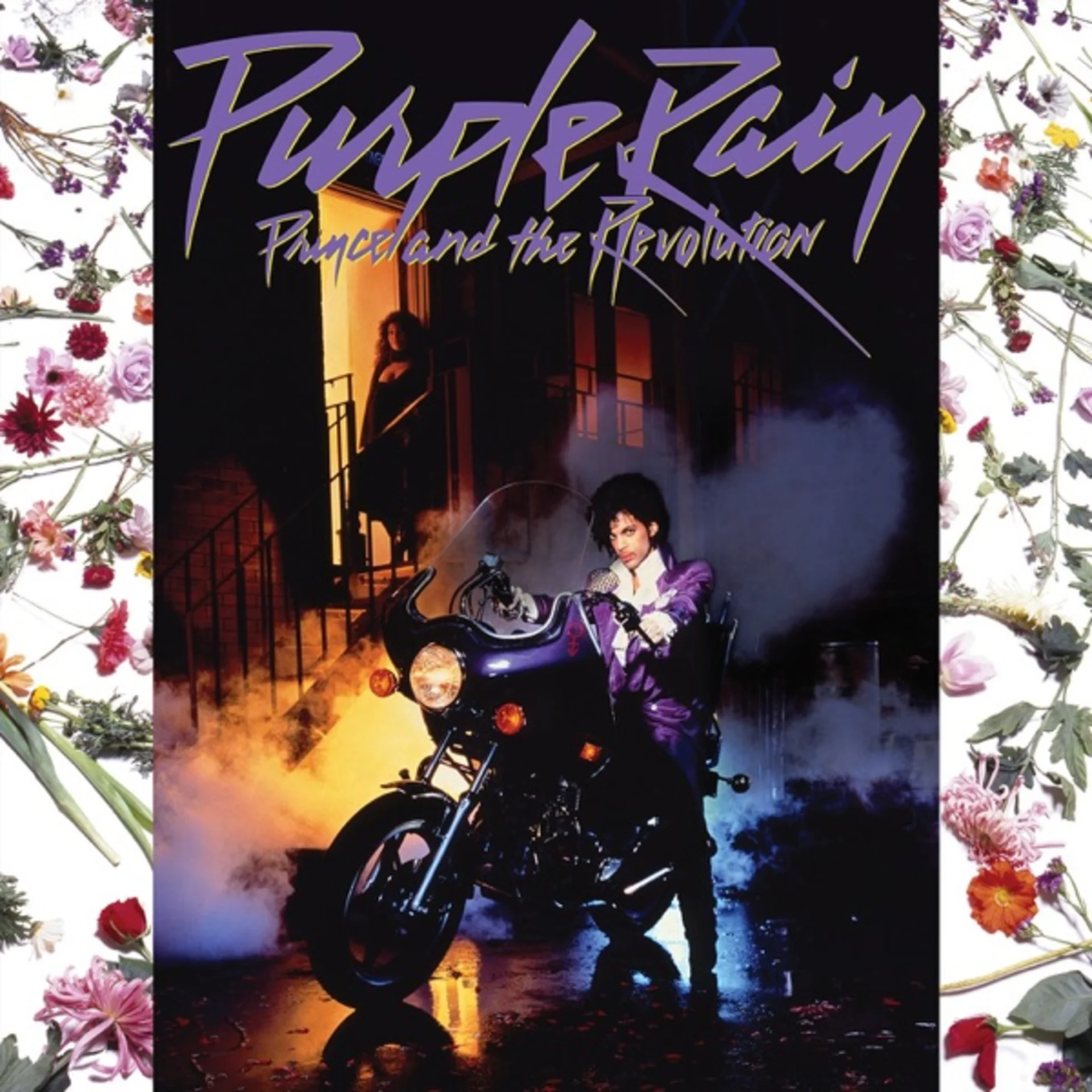
Ed Thrasher photographed Prince Rogers Nelson on a Hondamatic motorcycle in a haze of purple smoke and theatrical lighting, creating an image that collapsed the boundary between a man and his mythology. The shoot took place on a soundstage rather than a street, and every element was controlled: the smoke machines, the colored gels on the lights, the motorcycle's angle, Prince's costume of a purple brocade jacket with ornate buttons and a ruffled white shirt. Nothing in the image is candid or accidental, yet the result feels charged with a spontaneous, almost dangerous energy that transcends its calculated origins.
Prince sits astride the motorcycle with his legs extended and his body turned slightly toward the camera, one hand resting on the handlebar and the other hanging at his side. His posture communicates relaxed authority, the confidence of someone who controls the vehicle, the stage, and the gaze of everyone watching. The motorcycle is positioned at a three-quarter angle that gives it visual weight and mass, its chrome catching the purple-tinted light in highlights that punctuate the otherwise dark composition. Prince is small in physical stature, but the low camera angle and the motorcycle's bulk create a visual presence that fills the frame.
The purple that gives the album its title and its visual identity is not a single color but a range of violet, magenta, and indigo tones created by the interaction of colored gels and theatrical smoke. The smoke diffuses the light into a soft, enveloping haze that eliminates hard shadows and gives the image a dreamlike quality, as though Prince exists in a space where the normal rules of physics have been suspended. The purple carries associations of royalty, mystery, sexuality, and spiritual transcendence, all of which are central to Prince's artistic persona.
The composition is built around a strong central axis defined by Prince's body and the motorcycle, with the purple haze radiating outward from this core like an aura. The background is entirely abstract, all smoke and light with no architectural or geographic detail to anchor the scene in the real world. This placelessness is intentional: Prince's world is not Minneapolis or Hollywood but a private universe of his own creation, a kingdom of purple where the only subject is himself and the only law is his desire.
The lighting reveals Thrasher's skill in balancing theatrical effect with portrait photography's need for facial clarity. Prince's face is lit just enough to be fully legible: the high cheekbones, the carefully maintained facial hair, the eyes that look directly at the camera with an intensity that is simultaneously inviting and withholding. The rest of his body falls into softer light, his jacket's brocade pattern catching highlights that define its texture without competing with his face for the viewer's attention.
The typography uses a custom font for "Prince" and "Purple Rain" that combines elegance with rock-and-roll attitude, the letters slightly condensed and embellished with subtle serifs that reference both classical typography and 1980s pop design. The text is rendered in white, which floats forward from the purple background with clarity, and positioned at the top and bottom of the sleeve to frame the central image without interrupting it.
The album cover functions as the key image for an entire multimedia project: the film Purple Rain, released simultaneously, used the same visual vocabulary of purple lighting, theatrical smoke, and motorcycle iconography to construct Prince's public persona. The cover is not just album art but a movie poster, a fashion plate, and a self-portrait of an artist who understood that image and music were inseparable components of a single creative vision.
The cover's influence on pop music imagery in the 1980s was immediate and pervasive. It established the template for the pop star as mythic figure, photographed not in the documentary tradition of rock portraiture but in the theatrical tradition of Hollywood glamour. Prince's willingness to be both masculine and feminine, both powerful and vulnerable, both sexual and spiritual in a single image opened a space for visual ambiguity in popular music that artists from Madonna to Lady Gaga to Lil Nas X have continued to explore.
Get notified when we publish new cover stories. Download the Behind the Covers app and turn on notifications — a new album art deep dive, every day.
Loved the story behind Purple Rain? Hear the album or add it to your collection.
More by Prince
More Pop Covers
More from the 1980s
Want to explore more?
Never miss a new cover story
Get the Behind the Covers app and turn on notifications — we publish new album art deep dives every day.