Hot Fuss
The Killers · 2004
- Designer
- The Killers
- Label
- Island Records
- Decade
- 2000s
- Genre
- AlternativeRockIndie
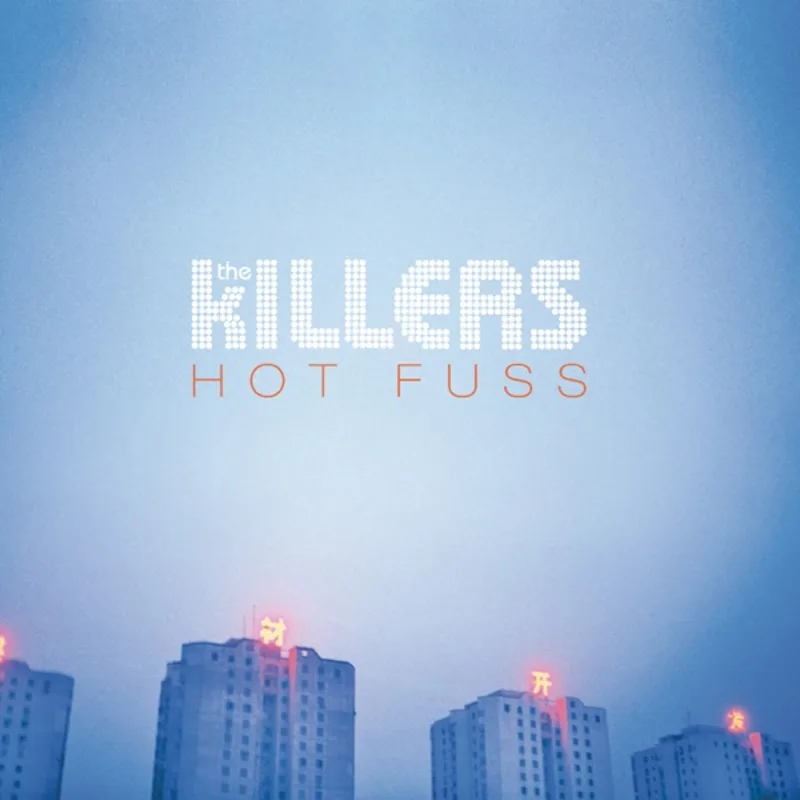
When The Killers were putting together their debut album Hot Fuss, they had virtually no budget for cover art — so they designed it themselves. The band's minimalist approach of white sans-serif text on a pure black background became one of the most recognizable album covers of the 2000s, proving that sometimes less truly is more.
The concept emerged from necessity rather than grand artistic vision. Brandon Flowers and the band wanted something that would stand out in record stores without resorting to the typical rock band photography that dominated shelves in 2004. They were influenced by classic punk and new wave album covers that used stark typography to make bold statements.
The execution couldn't have been simpler — white Helvetica-style lettering arranged in a clean, centered layout against a matte black background. The band chose to separate "HOT" and "FUSS" into two distinct blocks, creating visual breathing room that made the title more impactful. No special effects, no gradients, no fancy fonts — just pure typographic confidence.
The typography choice reflected the band's aesthetic sensibilities, bridging their love of 1980s new wave with contemporary indie rock minimalism. The Killers wanted the cover to feel timeless rather than trendy, avoiding the heavily processed digital effects that were popular in mid-2000s album art. The decision to use all caps gave the title an authoritative, almost confrontational presence.
Island Records initially had reservations about the stark design, worrying it might get lost among more colorful competitors on store shelves. However, the label ultimately supported the band's vision, recognizing that the bold simplicity aligned perfectly with The Killers' confident musical approach. The minimalist design became a talking point among music journalists and fans.
The cover's reception was overwhelmingly positive, with design critics praising its confident restraint. Music publications noted how the typography-only approach forced listeners to focus entirely on the music rather than visual gimmicks. The stark design became synonymous with the album's breakthrough success, selling over seven million copies worldwide.
The influence of Hot Fuss on subsequent album artwork was immediate and lasting. Countless indie and alternative bands adopted similar text-only approaches for their covers throughout the 2000s and 2010s. The design helped establish a template for how emerging bands could create striking artwork without expensive photography or elaborate concepts.
The cover's cultural impact extended beyond music into graphic design circles, where it's frequently cited as an example of effective minimalist communication. Design schools often use Hot Fuss as a case study in how typography alone can convey attitude and genre without additional visual elements.
Interestingly, the band later revealed they spent more time debating the exact shade of black for the background than any other aspect of the design. They tested multiple black inks and paper stocks to ensure the contrast with the white text would be as stark as possible, proving that even the simplest designs require careful attention to detail.
Loved the story behind Hot Fuss? Hear the album or add it to your collection.
More Alternative Covers


More from the 2000s




Want to explore more?